Evaluating Keysha Romie for Creative Projects
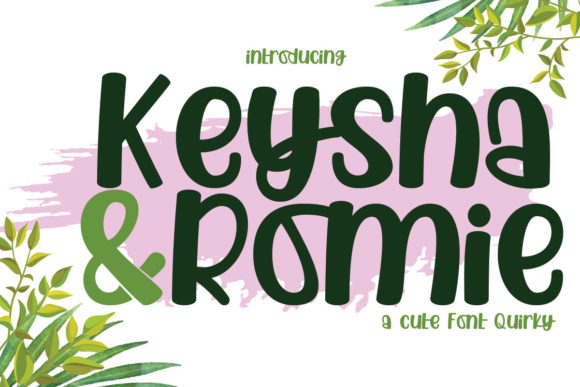
When selecting a typeface for a design project, the choice often extends beyond mere legibility. Designers frequently seek fonts that convey a specific personality, mood, or aesthetic nuance. In this landscape, Keysha Romie emerges as a distinct option for those looking to inject character into their work. Classified as a cute, quirky, and informal display font, it offers a visual language that is playful yet structured enough for various creative applications. This evaluation explores the technical specifications, aesthetic qualities, and practical use cases of Keysha Romie to help designers determine if it aligns with their current needs.
Understanding the Aesthetic Profile
The primary characteristic of Keysha Romie is its informal and quirky nature. Unlike traditional serif or sans-serif typefaces that prioritize neutrality, Keysha Romie is designed to stand out. The term "cute" in typography often refers to rounded forms, soft edges, and a friendly demeanor, while "quirky" suggests irregularities or stylized details that break conventional rules. This combination makes the font particularly effective in contexts where approachability and charm are desired.
As a display font, Keysha Romie is intended for use at larger sizes. Display fonts are not typically optimized for long-form body text due to their decorative nature. Instead, they serve as headlines, logos, posters, or social media graphics where immediate visual impact is crucial. The informal tone suggests that it works best in casual or creative environments rather than formal corporate communications. Understanding this distinction is vital for ensuring the font is used appropriately within a design hierarchy.
Technical Accessibility and PUA Encoding
A significant technical advantage of Keysha Romie lies in its encoding method. The font utilizes PUA (Private Use Area) encoding. To understand why this matters, it is helpful to look at how standard fonts operate. Most modern fonts map glyphs to standard Unicode code points, which ensures compatibility across different platforms and software. However, some custom or decorative fonts may lack these standard mappings, making them difficult to edit in certain word processors or web environments.
PUA encoding places the font’s unique characters, swashes, and alternate glyphs into the Private Use Area of the Unicode standard. While this area is reserved for private use and does not have universal standardization, it allows designers to access all available glyphs without relying on complex OpenType feature toggles that might not be supported in every application. For users working in graphic design software like Adobe Illustrator or Photoshop, this means you can access the full range of stylistic alternates and swashes with ease. You simply select the glyph from the font panel, and it appears in your document.
This accessibility reduces the friction in the design workflow. Designers do not need to hunt for specific features or worry about whether their client’s version of Microsoft Word will render the ligatures correctly. The tradeoff, however, is that PUA-encoded fonts can sometimes be challenging to copy and paste between different programs or embed in websites without additional font embedding tools. It is essential to test the font in your specific workflow before committing to it for large-scale projects.
Benefits of Using Keysha Romie
- Immediate Visual Appeal: The cute and quirky style grabs attention quickly, making it ideal for eye-catching headlines.
- Versatility in Niche Markets: It fits well within industries such as children’s products, lifestyle branding, crafting, and boutique retail.
- Easy Glyph Access: PUA encoding allows for straightforward selection of swashes and alternates in desktop publishing software.
- Informal Tone: It effectively communicates a relaxed, friendly, and human-centric brand voice.
Considerations and Potential Tradeoffs
While Keysha Romie offers distinct advantages, there are limitations that designers must consider. First and foremost, its readability is not suited for dense paragraphs of text. Using it for body copy can lead to reader fatigue and reduced comprehension. It should be reserved for short bursts of text, titles, or labels.
Secondly, the PUA encoding requires careful handling when sharing files. If you send a PDF created in Keysha Romie to a printer or another designer who does not have the font installed, the text may not substitute correctly unless the font is embedded properly. Furthermore, web developers cannot easily use PUA fonts via standard CSS @font-face imports without converting the font to a more standard format, such as WOFF2 with proper Unicode mapping. Therefore, if your project involves significant web integration, you may need to consult with a developer to ensure the font renders correctly across browsers.
Another consideration is the subjective nature of "cute" and "quirky." What one audience finds charming, another might perceive as unprofessional or childish. It is crucial to evaluate the target demographic. If the goal is to appeal to a mature, corporate, or luxury market, Keysha Romie is likely a poor fit. Conversely, for brands targeting Gen Z, millennials, or families, the font’s personality can be a strong asset.
Ideal Use Cases
Keysha Romie shines in specific scenarios where personality outweighs strict formality. Consider using this font for:
- Brand Identity for Lifestyle Brands: Small businesses selling handmade goods, organic foods, or pet products can benefit from the warm, approachable feel of the typeface.
- Social Media Graphics: Instagram posts, Pinterest pins, and Facebook banners often rely on bold, readable, and attractive typography to stop users from scrolling. Keysha Romie’s display quality makes it perfect for these formats.
- Event Materials: Invitations for birthdays, baby showers, or casual parties can leverage the font’s informal charm to set the right tone.
- Product Packaging: Labels for cosmetics, candles, or specialty snacks can use the font to differentiate themselves on crowded shelves.
When to Choose Alternatives
There are situations where Keysha Romie may not be the best choice. If you are designing a financial report, a legal document, or a news website, a neutral sans-serif or serif font would be more appropriate. These contexts demand clarity, authority, and trustworthiness, which quirky fonts can undermine.
Additionally, if your project requires extensive multilingual support, check if Keysha Romie includes the necessary character sets for other languages. Many display fonts focus primarily on Latin characters and may lack accents or scripts needed for global audiences. In such cases, a more robust, universally encoded font would be a safer bet.
Final Decision-Making Insights
Selecting Keysha Romie is less about finding a "best" font and more about finding the right tool for a specific job. Its strengths lie in its ability to convey a specific mood—playful, informal, and distinctive. The PUA encoding simplifies the technical aspect of accessing its full glyph set, allowing designers to experiment freely with swashes and alternates.
To make an informed decision, start by defining the emotional response you want your audience to have. If you aim for warmth, creativity, and informality, Keysha Romie is a strong candidate. Test the font in mockups of your actual final product. See how it looks alongside your brand colors and imagery. Ensure that the file formats you plan to use support the font’s encoding requirements. By balancing aesthetic appeal with technical practicality, you can confidently integrate Keysha Romie into your creative toolkit.